
Solar energy is a prominent part of the global energy transition towards sustainable
and renewable sources of electricity. From utility-scale solar farms to commercial
and industrial rooftop systems, solar plants represent a valuable investment that
aims to provide businesses and enterprises with significant reductions in electric bill
expenses, and energy independence from conventional sources of electricity. Yet,
the installation of the photovoltaic (PV) modules is only a small part of operations
that a business must consider when pursuing continuous and uninterrupted power
generation from solar sources.
A solar power plant is a complex system whose performance is influenced by various
parameters, ranging from sunlight availability to inverter performance. Generation
losses can occur for numerous reasons, including system faults, equipment failure,
misalignment, and others. For example, shaded modules or those operating below
the rated power capacity of an inverter can contribute to reduced power generation.
Thus, what can be done to improve the performance of a solar plant and get more
electricity out of the existing system? In this article, we will discuss how to improve
solar power generation, increase the reliability of plants, and prevent avoidable
electricity losses.
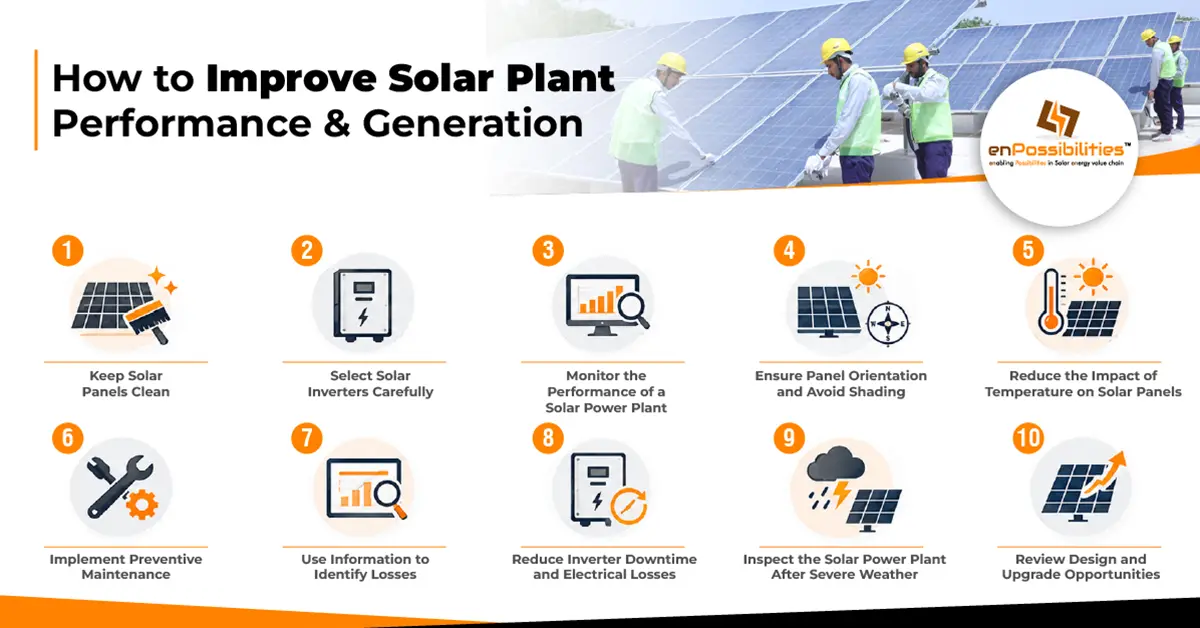
Effective Tips to Improve Solar Plant Performance
1. Keep Solar Panels Clean
Solar panels typically require scheduled cleaning and maintenance to ensure that no
foreign objects reduce the amount of incident sunlight that can interact with the PV
cells inside the module. The accumulation of dust, dirt, bird feces, leaves, and other
materials can obstruct incoming sunlight and reduce the energy output of a solar
panel.
It is particularly important to keep solar panels in clean condition in arid regions,
industrial areas, and other locations where the amount of particulate matter in the
air is particularly high. A special cleaning schedule should be established depending
on the local environment and weather conditions. It is important to use the right
equipment and methodology to avoid damaging the surface of the solar panel.
Particularly for large solar farms, a systematic approach to cleaning can help
minimize operations and expenses while keeping generation losses to a minimum.
2. Select Solar Inverters Carefully
A solar inverter is a central part of any solar power plant. It is the device that allows
the direct current (DC) generated by the PV modules to be converted into alternating
current (AC) that can be utilized by most electrical equipment and connected to the
grid. Thus, it is important to select high-quality and reliable inverters and converters
that will meet the needs of the solar farm.
Specifically, the power rating and operating characteristics of the inverter should
correspond to the design specifications of the solar power plant. Modern devices
typically feature functions such as monitoring and control, fault diagnostics, and
remote access to data about the performance of the inverter.
For utility-scale solar power plants, it is particularly important to choose the right
technology that would meet the requirements of the local environment and
minimize the possibility of system failures.
3. Monitor the Performance of a Solar Power Plant
Probably one of the simplest yet most effective ways to improve solar generation is
to monitor the performance of the plant and identify possible causes of deviations. A
solar plant owner should ensure that they review the information about the daily or
hourly generation of the plant, and bring this data to the attention of maintenance
teams when necessary.
A SCADA system can greatly facilitate the identification of parameter shifts and
irregularities in the operation of the equipment. It is important to track changes in
the operating characteristics of inverters and compare this information with similar
devices in the plant. It is also helpful to correlate this information with the expected
or designed generation of the solar power plant.
If one inverter in the solar power plant performs significantly worse than the others,
this may indicate shading, faults in the connected strings, or communication issues.
Consistent performance analysis helps eliminate avoidable losses due to equipment
failures.
4. Ensure Panel Orientation and Avoid Shading
To ensure high solar power generation, it is important to ensure that the solar panels
are positioned correctly and that their orientation allows them to receive the
maximum amount of sunlight. Shading of the solar panels, whether caused by trees,
buildings, poles, or other structures, should be minimized during the design and
maintenance stages of a solar plant.
Depending on the technology of the inverter and the type of inverter connection,
plant operators may notice that shaded strings or modules have significantly lower
energy output. In addition to analyzing the impact of shading on individual strings or
modules, it is important to consider the shading of the entire solar power plant.
It is especially important to design the solar power plant in such a way that the
distance between rows of solar panels is wide enough to allow sunlight to reach all
modules throughout the year.
5. Reduce the Impact of Temperature on Solar Panels
One of the key characteristics affecting the performance of solar panels is
temperature. Solar modules typically experience a decrease in energy output when
the temperature is higher than the standard conditions (STC). Although a sunny day
ensures that the solar panels will receive plenty of sunlight, very hot temperatures
can reduce the voltage output of the PV modules.
In hot weather, the temperature of the inverter can also rise, degrading its
performance depending on the technology and equipment. To reduce the impact of
high temperatures on the performance of a solar power plant, it is important to
ensure that the equipment has proper airflow and is not blocked by foreign objects.
Particularly for string inverters, it is important to ensure that the inlet air is not
obstructed and that the equipment is not placed in areas with insufficient airflow. If
applicable, it is important to check the condition and performance of the fans and
filters and address any abnormal temperature alarms.
6. Implement Preventive Maintenance
When designing a maintenance schedule for a solar power plant, it is important to
consider not only equipment failures but also potential equipment damages that
may require extensive and expensive repairs. Preventive maintenance can help
identify potential problems before they affect the operation of a solar power plant.
A preventive maintenance program should include a detailed inspection of cables,
connections, junction boxes, mounting structures, grounding, surge protective
devices, and other equipment. In addition, it is important to check for signs of
corrosion, water ingress, damaged insulation, and faulty connections during
maintenance.
Electrical equipment and cable connections should only be serviced by certified
electricians following all applicable regulations and safety standards. In addition, all
equipment should be properly maintained in accordance with the manufacturer’s
recommendations and industry standards.
7. Use Information to Identify Losses
In addition to maintaining equipment and minimizing equipment failures, it is
important for solar power plant operators to analyze statistics and assess how much
electricity the plant generates on a daily basis compared to the designed or expected
performance. Information about the current generation of the solar power plant can
help determine whether there are performance issues that require further
investigation.
Some operators choose to track information about the daily plant generation, while
others opt for a more detailed analysis of the performance of each inverter and
power plant section. Using a monitoring system can greatly facilitate the analysis of
trends and statistics.
The performance ratio is one of the key metrics that reflects the power generation
performance of a solar power plant. Using this metric, it is possible to estimate how
much electricity a solar power plant is capable of generating given the available solar
resource and the losses due to equipment performance. Other metrics, such as
specific yield and the ratio of plant generation to inverter capacity, can also be used
to evaluate performance.
8. Reduce Inverter Downtime and Electrical Losses
Since inverters are responsible for converting the direct current produced by the
solar panels into alternating current, their proper operation is critical for the
uninterrupted generation of electricity. Ideally, inverter downtime should be
minimized to avoid unnecessary losses of electricity. In addition, it is important to
review the reasons for inverter downtime and address the recurring issues.
Operators should ensure that they react promptly to faults and alarms reported by
the inverters. It is a good idea to establish a procedure for reporting and addressing
these issues. To minimize downtime and maintenance costs, it is important to have
access to the right spare parts and technical support.
To minimize electrical losses, it is important to ensure that DC and AC cable cross-
sections correspond to the requirements and are not damaged. Where applicable,
operators should also consider the impact of voltage drops and minimize the impact
of resistive losses on the performance of the solar power plant.
For large-scale solar power plants, it is a good idea to track the cumulative downtime
of each inverter and analyze the reasons for these downtimes.
9. Inspect the Solar Power Plant After Severe Weather
Strong winds, torrential rains, storms, and other severe weather conditions can
damage equipment and structures at a solar power plant. High winds can push
against solar panels and cause damage to the mounting structures. Water ingress
can damage electrical equipment and create dangerous conditions for maintenance
personnel.
During strong winds and heavy thunderstorms, it is a good idea to limit access to the
solar power plant and protect the equipment from the effects of severe weather.
After severe weather conditions, it is important to inspect the solar power plant and
look for signs of damage.
It is important to follow all applicable regulations and only authorize personnel with
the required training to work on electrical equipment. In addition, electricity at
flooded electrical panels should not be turned on until the safety of the equipment is
confirmed.
10. Review Design and Upgrade Opportunities
Even if the owner of a solar power plant is aware of the main operating principles
and potential causes of equipment failure, it is important to take a closer look at the
design and operating characteristics of the plant. Sometimes the source of the
problem may be the equipment or the way the solar panels are connected to the
inverter.
When reviewing the characteristics of the solar power plant, it is a good idea to take
a closer look at the potential for losses. These can include losses at the level of
strings or modules, equipment failures, downtime, and other issues. Upgrading the
monitoring equipment, replacing low-quality or damaged components, or optimizing
the communication infrastructure can be a solution in some cases.
In addition, it is important to consider whether the equipment corresponds to the
requirements and technical specifications. If these requirements are not met, the
equipment may be forced to operate in conditions for which it was not originally
intended.
Any improvements to the solar power plant should be based on a thorough technical
and economic analysis of the benefits and costs. Solar power plant owners should
calculate how much additional electricity the proposed solution would allow them to
generate and whether the costs would be justified in the context of the project’s
economic performance.
Conclusion
Improving solar power generation is a complex process that involves a close
examination of equipment performance and identifying ways to reduce avoidable
losses. Cleaning the solar panels, choosing the right inverter solution, and
implementing a monitoring system are only some of the ways to improve the
performance of a solar power plant.
Solar plant owners and operators should not only be interested in getting more
electricity from their plants but also ensuring that the equipment functions reliably
and safely. This way, the owners will be able to increase the reliability and
availability of the solar power plant and get more electricity from their system over
its entire service life.
Frequently Asked Questions (FAQs)
1. How can I improve solar plant generation?
Improving solar plant generation can be achieved through various methods, such as
cleaning solar panels, avoiding shading, monitoring inverter performance, and
reducing the likelihood of equipment failure.
2. What factors affect the performance of a solar power plant?
Several factors can reduce the performance of a solar power plant, including
temperature effects, accumulation of dust on solar panels, shading of modules, and
equipment failures.
3. How often should I clean my solar panels?
Depending on the amount of dust in the air and the local weather conditions, a
special cleaning schedule should be established. In addition, all recommendations
specified by the equipment manufacturer should be followed.
4. What is the role of an inverter in a solar power plant?
An inverter is a device that converts the direct current generated by solar panels into
alternating current. The quality and performance characteristics of the inverter
affect the overall performance of the solar power plant.
5. What is the performance ratio of a solar power plant?
The performance ratio is a metric that is used to evaluate how much electricity a
solar power plant can theoretically generate given the solar resource and the losses
due to equipment performance. This metric is usually expressed as a percentage.
6. How can I use a monitoring system to reduce losses?
By analysing the data provided by a monitoring system, it is possible to find out
about the failures of individual equipment, communication problems, or differences
in the performance of various sections of the solar power plant. The earlier the
issues are identified, the faster they can be resolved.
7. Can high temperatures reduce the amount of electricity generated by a solar
power plant?
Elevated temperatures can have a significant effect on the performance of a solar
power plant. In particular, solar panel modules tend to decrease their voltage output
when the temperature is higher than the standard test conditions.
8. Why is preventive maintenance important for a solar power plant?
Preventive maintenance helps to ensure that equipment is operating safely and
reliably, reducing the risk of unexpected failures and associated losses of electricity
generation.