
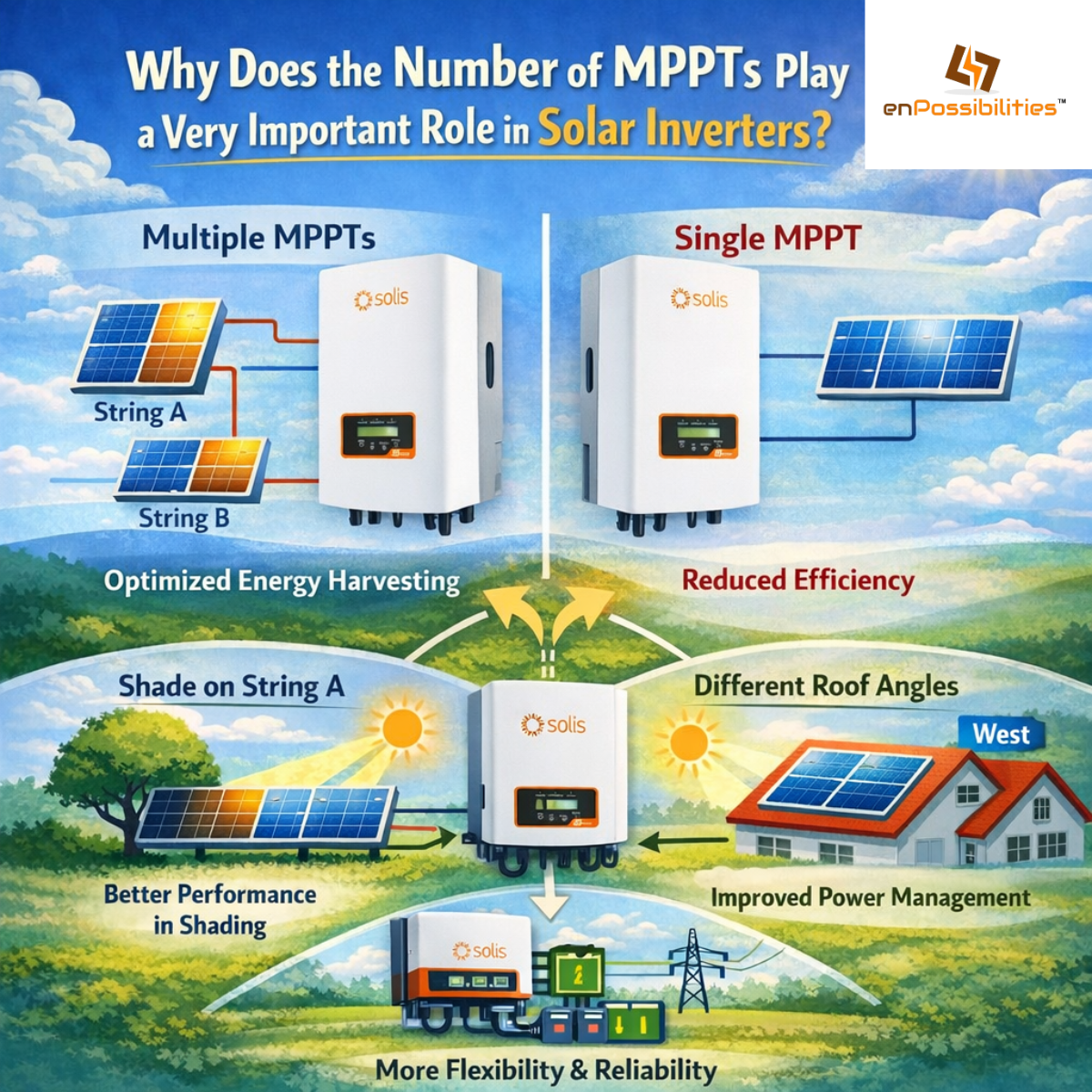
When choosing a solar inverter, many people check power rating, brand, or warranty. But one important feature that is often ignored is the number of MPPTs.
The number of MPPTs directly affects how much electricity your solar system can produce.
Let’s understand this in simple words.
First, What Is MPPT?
MPPT stands for Maximum Power Point Tracker.
It is a technology inside the inverter that makes sure your solar panels produce maximum possible power throughout the day.
Solar panels don’t produce the same power all the time. Their output changes due to:
- Sunlight intensity
- Temperature
- Shade
- Dust
- Panel direction
MPPT adjusts the voltage and current continuously so you always get the best output.
What Does “Number of MPPTs” Mean?
An inverter can have:
- 1 MPPT
- 2 MPPTs
- 3 or more MPPTs
Each MPPT works independently.
This means each MPPT can control a separate group (string) of solar panels.
Why More MPPTs Matter
1. Better Performance with Different Panel Directions
If your panels face different directions (for example, some facing east and some west):
- A single MPPT inverter may reduce overall performance.
- A dual MPPT inverter allows each direction to work independently.
Result: Higher energy generation.
2. Handles Partial Shading Better
If some panels get shade from:
- Trees
- Water tanks
- Buildings
- Chimneys
With only one MPPT, shading on one panel can affect the entire system.
With multiple MPPTs:
- Only the shaded string is affected.
- Other panels continue working at full capacity.
Result: Less power loss.
3. More Flexible System Design
Multiple MPPTs allow:
- Different panel capacities
- Different tilt angles
- Expansion in the future
This is very useful in homes and commercial buildings where roof space is limited or uneven.
4. Higher Overall Efficiency
More MPPTs mean:
- Better optimization
- Reduced mismatch losses
- Maximum power extraction
In real-world conditions, this can increase annual energy production significantly.
Example (Simple Comparison)
Imagine you have 10 panels:
- 5 facing east
- 5 facing west
With 1 MPPT, the inverter treats all panels the same. Output may drop.
With 2 MPPTs, each group works independently. You get better morning and evening output.
When Is 1 MPPT Enough?
1 MPPT is fine if:
- All panels face the same direction
- No shading issues
- Simple, small installation
When Should You Choose 2 or More MPPTs?
Choose multiple MPPTs if:
- Roof has different directions
- Shading is unavoidable
- It’s a commercial installation
- You want maximum performance
- You plan future expansion
Final Thoughts
The number of MPPTs plays a very important role because it directly affects:
- Energy generation
- Efficiency
- System flexibility
- Long-term savings
More MPPTs = Better control = More power output.
When selecting a solar inverter, don’t just check the kW rating. Always check how many MPPTs it has. It can make a big difference in your solar returns. Explore premium solar panels from Swelect Solar and Saatvik Solar available in India.