
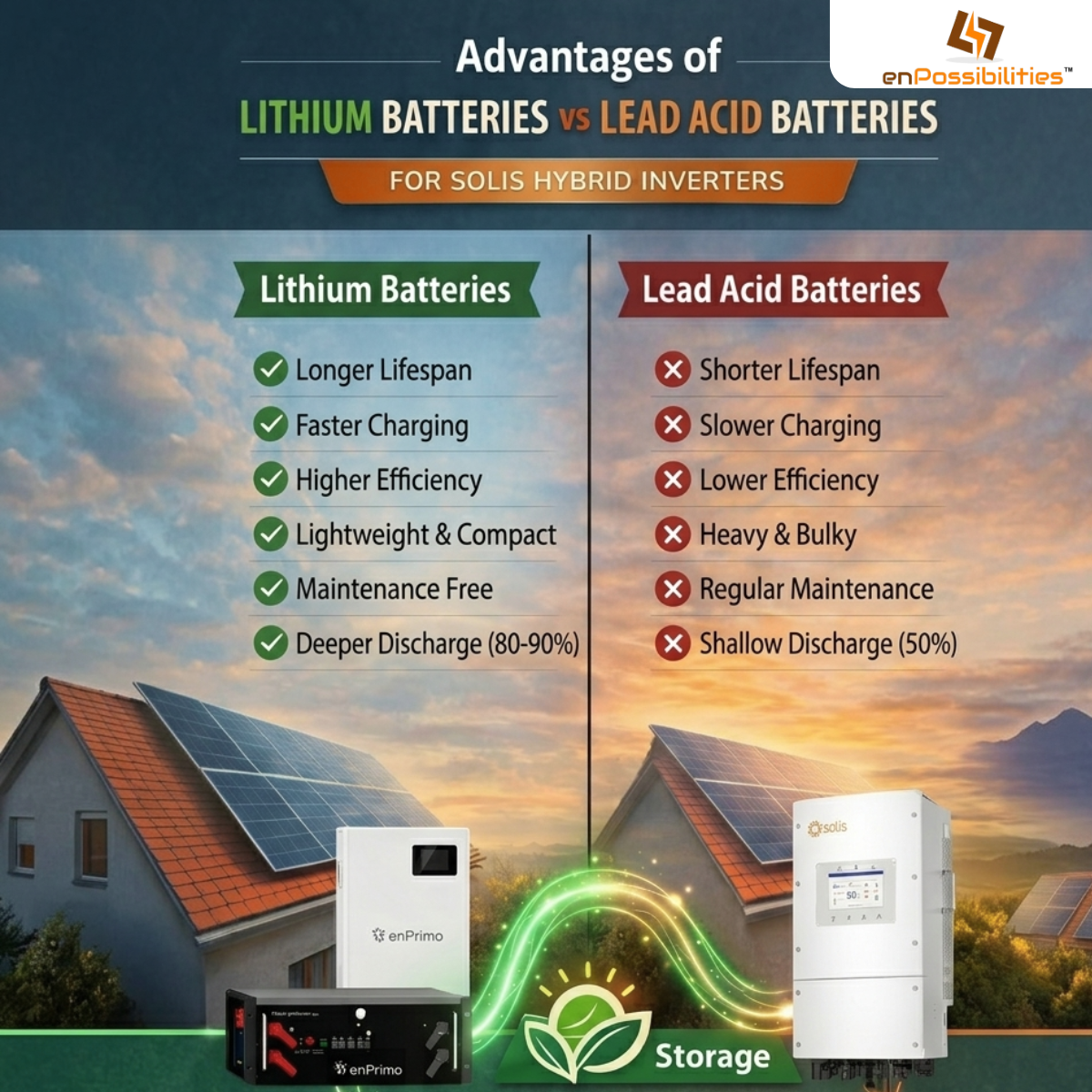
Hybrid inverters such as Solis can work with both lithium batteries and traditional lead-acid batteries. However, in modern solar systems, lithium batteries are becoming the preferred choice because they perform better and last longer.
Choosing a battery for your Solis hybrid inverter is the difference between buying a tool that lasts a decade and one you’ll be wrestling with in three years. To explain this in a way that is both technical and easy to understand, we have to look at the “hidden” mechanics of how these batteries actually work with your inverter.
Why Lithium Batteries Work Better with Solis Hybrid Inverters
1. Depth of Discharge – The Energy You Can Actually Use
Technical: Lead-acid batteries have a high internal resistance. If you drain them below 50%, the chemical reaction becomes irreversible, leading to “sulfation” (hard crystals forming on the plates). Future of Solar Hybrid Systems uses a much more stable chemical structure that can handle deep cycles without breaking down.
- The Simple Way: Imagine you buy a 10kWh battery. If it’s Lead-Acid, you can only use 5kWh before you have to stop. If it’s MPPTs in Solar Inverters, you can use almost the whole 10kWh.
- Why it matters for Solis: You would need a lead-acid bank twice as big (and twice as heavy) to get the same amount of daily power as one lithium unit. Also, using IP65/IP66 Solar Inverter Protection ensures safe and long-lasting performance in harsh weather.
- Cost Advantage: Installing solar systems with GST Reduced Rooftop Solar Costs India can also make hybrid setups more affordable.
2. The Smart Connection BMS Communication-
Technical: Solis hybrid inverters use a communication protocol (CAN or RS485). Lithium batteries have a Battery Management System (BMS)—a computer board that monitors every single cell. Lead-acid is a “dumb” technology with no digital brain.
- The Simple Way: A Lithium battery talks to your inverter through a data cable. It tells the inverter, “I’m 40% full, please charge me at exactly 50 Amps.” Lead-Acid can’t talk. The inverter has to “guess” how much energy is left by looking at the voltage, which is like trying to guess how much gas is in a car by listening to the engine.
- Why it matters for Solis: The smart connection prevents the battery from overcharging or getting too hot, making the whole system much safer.
3. Charging Efficiency Wasted Power-
Technical: Lead-acid batteries have a “round-trip efficiency” of about 80%. This means for every 100 units of energy your solar panels send to the battery, you only get 80 back. Lithium is 95–98% efficient.
- The Simple Way: Lead-Acid batteries get warm when they charge; that heat is literally your money and solar power disappearing into thin air. Lithium stays cool and keeps almost all the power you put into it.
- Why it matters for Solis: On a cloudy day with limited sun, every bit of power counts. Lithium ensures you aren’t wasting 20% of your free solar energy just to “fill the tank.”
4. Cycle Life The Daily Wear and Tear-
Technical: Every time you charge and discharge a battery, it’s called a “cycle.” Lead-acid plates physically degrade slightly with every cycle. Lithium ions just move back and forth between the anode and cathode with very little physical wear.
- The Simple Way: A Lead-Acid battery is like a cheap lightbulb—it’s good for about 500 to 1,000 uses before it burns out. A Lithium battery is like an LED; it’s rated for 6,000+ uses.
- Why it matters for Solis: In a solar setup, you use the battery every single night. Lead-acid will die in 2–3 years. Lithium will keep working for 10–15 years
5. Charge Speed Catching the Sun-
Technical: Lead-acid batteries have a limit on how fast they can accept current (usually 10-20% of their capacity). They also need a long “Float” stage at the end to stay healthy. Lithium can take a high current (up to 100% of capacity) almost all the way to the top.
Top solar battery brands that work efficiently with hybrid inverters include: SWELECT ENERGY SYSTEMS, SAATVIK GREEN ENERGY, and JINKO SOLAR.
- The Simple Way: Lead-Acid is a “slow eater.” If the sun comes out for 3 hours, the battery might only reach 70% charge. Lithium is a “fast eater”—it can soak up all that solar power in a fraction of the time and be ready for the night.
Comparison Summary
The Bottom Line: Lead-acid is cheaper on the first day, but because you have to replace it every few years and can only use half the power, it ends up being much more expensive. Lithium is the professional choice for any Solis system.